Friday, 14 November 2014

Cheese recipe - Hungarian cheese spread

I found a Hungarian cheese recipe the other day which seems similar to the German obatzda, and decided to make it up. I particularly like the way the raw garlic cuts through the creaminess of the cheese and cream. Good on bread - excellent on toast. If you make your own cheese, it's a good way of using it fresh. Otherwise, use soft curd cheese or cottage cheese, or a mix of the two.

Ingredients: about 500g fresh curd cheese, chopped onion, chopped garlic, paprika, mustard powder, caraway seeds, a few tablespoons of sour cream

Chop your onion and garlic. Beat the sour cream into the cheese. Mix a tablespoon or two of paprika (you can use a lot more than you think!), a couple of teaspoons of mustard powder, and a teaspoon of caraway seeds into the cheese, and then add the onion and garlic.

I'm told this is traditionally made with a Liptauer sheep's milk cheese. However it works well with my own home made cow's milk cheese, and keeps a good few days in the fridge.

Tuesday, 21 October 2014

DIY cheese

It had to happen. I saw a cheese-making machine at a car boot sale. Time to move from being an avid consumer to making my own cheese. Three euros was my in-price. That gets me the machine, with its glass insert, and a plastic 'faisselle' or strainer-thingy inside that.
Recipes abound on the internet and all are slightly different. Some start by using a petit suisse or a fromage blanc from the supermarket as a starter. Some use rennet, some use lemon juice, some use vinegar. I've tried it all ways and it doesn't seem to make a lot of difference.
There is a kind of magic to a natural process. Making perry, or beer, or wine, through fermentation; watching your bread rise as the yeast starts pushing air out through your dough; making your own yogurt (which, in fairness, you could also use this little machine for - a cheesemaker and a yogurtmaker are not very different, it's basically a matter of keeping your milk at a constant, warm temperature).
The magic of this process is putting the milk in just before dinner time, seeing the milk just a bit thickened by the time you go to bed, and coming down early in the morning to see solids starting to clump together.
It tastes good. Light, creamy, full, fresh.
Even better, I've learned how to make ricotta. You take the whey, boil it with the addition of about another half its volume in fresh milk, add a little lemon juice, and leave it to do its thing. Strain it out, and there's the ricotta; not as creamy as what you get from the supermarket (actually I found the addition of a little creme fraiche made it taste better, but the texture was still quite granular), but wonderfully soft.
The next step, if I want to take it, will be to buy some cheese moulds from Tompress (superb if expensive supplier of all kinds of kitchen and smallholding equipment) and dry out the fresh cheese for longer storage. But at the moment, we're eating all the cheese I produce fresh, in just a couple of days, and very nice it is, with chives and a little salt, or with sugar, or served up with fruit, or used in a vegetable gratin.
We all need a little magic in our lives. For so little investment, and so little effort, I now have some cheesemaking magic in mine.


Thursday, 28 August 2014

Cheese recipes of the Auvergne


I first encountered aligot when I walked to Santiago de Compostela from Le Puy - the old pilgrim path which starts in the remote mountains of the Auvergne, before descending to the limestone causses, and then the fertile plains of Gascony. It's a dish that must have been invented to supply the needs of hard-working peasants or hard-walking pilgrims; full of cheese, cream, and carbohydrates, enough stodge to fill the stomach and boost your energy.

Aligot blends tomme d'Auvergne or Laguiole cheese into mashed potatoes, with the addition of butter and cream and garlic. It's cooked slowly, till all the ingredients are blended and the mixture becomes smooth, and if you put a fork into it, you can pull out thin strings of incredible strength and fineness.

Of course, pre-1492, Aligot was not made with potatoes. It was made with stale bread, instead - a bit like migas in Spain, or fattoush in the Middle East, a way of using up the odds and ends, which made it an economical way for the monks to feed pilgrims.

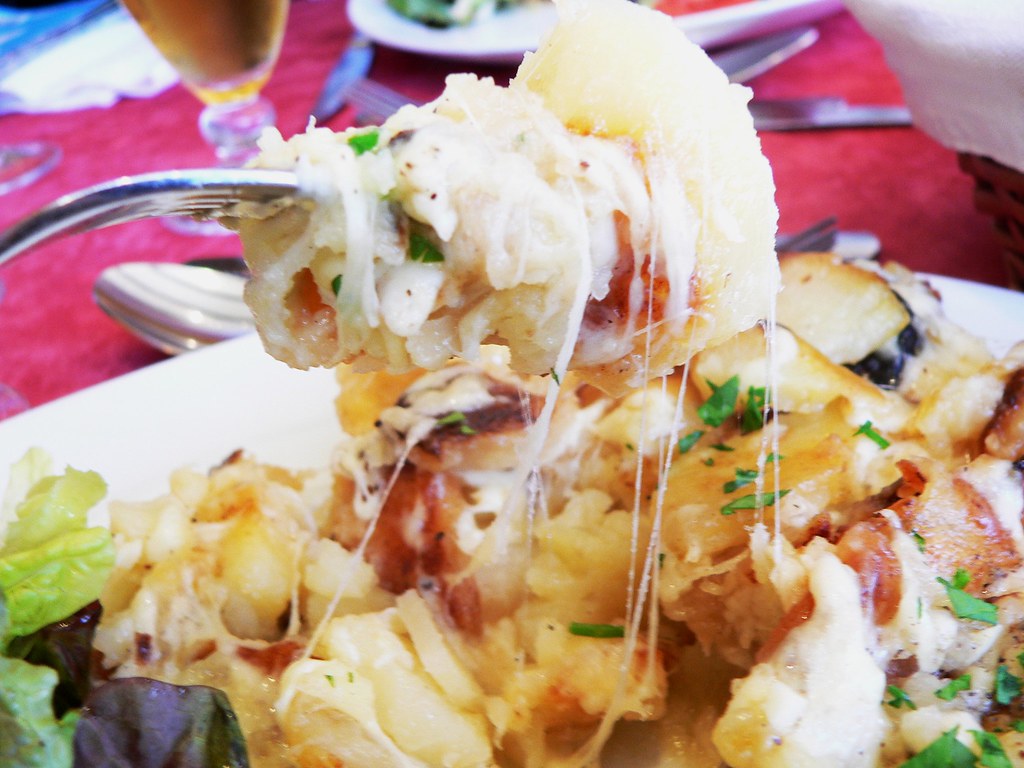
Now, aligot is a recipe you find in the Aubrac. But in other areas of Auvergne, around Clermont-Ferrand and down to Aurillac and Carlat, you find truffade. Again, the main ingredients are potatoes and chees - preferably Salers or tomme fraiche du Cantal - but for truffade, the potatoes are slowly fried, and then the cheese is added to make a sort of lasagne or pancake. There may or may not be garlic (depending on where you are - not in Cantal, apparently).

I've eaten truffade with just a green salad, the crunchiness of endive and lettuce neatly offsetting the waxy potato and creamy cheese. It goes well with local ham and other charcuterie. I'm told some chefs make it with fourme d'Ambert instead of tomme fraiche or Salers, the blue cheese giving it a quite different character. There are even controversies about whether you let the potatoes or the whole dish crisp up on the outside, or not. I prefer it with the little golden brown bits of crispiness, the way the Bar du Palais in Murat serves it.

Truffade has nothing to do with truffles, by the way. Trufa, in Auvergnat dialect, is a potato.

I have to say that though I'm a big fan of both, I prefer aligot. Its creaminess nicely counterpointed by that little edge of garlic, the nutty flavours of the cheese coming through strongly, the grainy and stringy textures... mmm. Very nice. How lucky the Auvergne is to have such good cheese recipes - and such good cheeses.

Saturday, 16 November 2013

Cheese recipes

One specific reason that I don't like cheese-with-things-in is that I like to do my own thing with cheeses. Just as I don't buy supermarket curries, but prefer to cook my own, I like to make my own cheese preparations. The recipes are simple. I don't do quantities - it's very much 'suck it and see'. In fact, in the case of feta, I don't do recipes - I simply look around to see what we've got in the garden or the store cupboard, and invent something that works.

Brie and walnuts
This is very simple. The only slightly difficult part is holding the wobbly cheese straight while you slice through it horizontally. Then you grab a handful of walnuts, scatter them on the cut side of one half of the Brie, and sandwich it with the other half. Press gently under a weight for a few hours.

Potted Stilton
Mash two parts of Stilton to one part butter. Add a little mustard, and start adding port, till you've got the texture just about right. Pack the mixture into ramekins, then seal with a little melted butter poured over the top.

Really good with thin, crisp, freshly made toast. (Proper toast, not rubbish supermarket sliced white bread in a toaster, please.)

Feta spread
Never buy processed dips and spreads again! Fresh ingredients make life tastier. Feta cheese is a good basis for all kinds of spreads and dips. Simply put the ingredients in a food processor and blitz yourself a good time.
  • feta, walnut, dill, roasted red peppers, olive oil
  • feta, black olives, oregano, olive oil
  • lemon, fresh mint, garlic, olive oil
Yogurt can be added to make the mix a little lighter and more liquid.

Wednesday, 13 November 2013

Brillat-Savarin

I don't approve of cheese-with-things-in. You know the sort of thing; industrial double Gloucester with little flecks of sage that's too green to be real, cheddar with chilis, all sorts of cream cheese with nuts or garlic or chocolate or some other ingredient that's supposed to make it taste of something, because without that, it tastes of nothing at all.

We're all sinful human creatures, though, and occasionally hypocrites, and yesterday I fell for a cheese I don't approve of and would never take home to introduce to my father, so to speak. It's a Brillat-Savarin encrusted with cranberries. (I know I could quibble, and pretend to myself that encrustations don't really count, it's only when you put cranberries inside the cheese that it's wrong... but that would be mere casuistry.)

Now Brillat-Savarin is probably the creamiest of French cheeses; not just in texture, but in taste, it seems hardly far removed from a good clotted cream. The one I tasted was Burgundian by provenance, though apparently - and unusually for a French cheese - it's produced in other places as well, in Normandy and in the Ile-de-France (which is, apparently, its original home).

The name comes from eitheenth-century epicure and food writer (and lawyer) Jean-Anthelme Brillat-Savarin, though the cheese only dates from the 1930s making it a bit of a Johnny-come-lately in the French cheese stakes. The milk for the cheese is enriched by the addition of cream; with a 75% fat content, it qualifies as a triple cream cheese (fat content, by the way, is measured as a percentage of the dry content of the cheese - as a percentage of the total mass of the cheese, it's far less, as this is a cheese with a high moisture content). It's a virginal cheese in visual appeal, with its soft plush white rind and almost white (the palest of pale yellows) interior, and only a tiny touch of sourness sets off the intensely creamy taste.

Like many other French cheeses, it's available at different ages, with slightly different characters;
  • fresh - the way I had it - it's incredibly creamy, 
  • a few weeks old, it's mushroomy, but still creamy - far more so than a Brie. The mouthfeel is different; a Brie sticks to the palate, a Brillat-Savarin dissolves creamily. (I notice that I'm overusing the word 'creamy', but there really is no alternative. Unctuous, perhaps...)
  • aged a little more (as 'Pierre Robert') it becomes earthier and saltier. 
The intense creaminess of the cheese makes it a natural pairing for a fruit that is slightly tart and can cut through and set off that sweetness. The cranberry coating did that well. Since it's a coating - the cheese simply seems to have been rolled in chopped cranberries before packing - a slice of cheese will include a mouthful or two that's nearly all cranberries, and a mouthful or two of almost pure cheese, and a good few mouthfuls somewhere in-between. It's not a homogeneous mix.

Add to this a hunk of roughly torn, crusty baguette, and you have a little taste of heaven. Only the harp music and perhaps a glass of champagne is missing.

Monday, 8 October 2012

Abondance

Abondance is a cheese I always associate with autumn, though it's available from July through to Christmas;  it's a fairly youthful cheese, with a maturation period of only 90 days, made in Savoy, near the Swiss border. This is one of France's oldest cheeses, dating from the twelfth century when it was made by the monks of Sainte Marie de l'Abondance abbey; it was served to the Papal conclave that met in Avignon in 1381.It's been an AOC since 1990 (in fact, two AOCs, Abondance, and Abondance de Savoie - though both come from Haute-Savoie, though the distinction suggests otherwise).

It's nutty, reminiscent of hazelnuts to be precise, and slightly acidic - with a lemony edge to it - and creamy in taste; firm, slightly chalky in texture. The one I tasted this week I find slightly too young - the taste is at first almost imperceptible. You have to be patient, chewing and holding the cheese in your mouth without swallowing, to let those nutty, tart flavours come through (and they do). (It's a little like Comté or Beaufort, but I find it less grainy and dry than most Comtés.)

It's a holey as well as a holy cheese, but unlike, say, Emmenthal with its round, large, holes, tends to develop horizontal fissures. The consistency is quite hard, but still creamy; not chewy and glossy like Emmenthal, not quite as creamy as Saint-Nectaire, and chalkier than Comté.

Abondance comes in a small wedge, with a thin, orangeish rind; each disc of the cheese weighs about ten kilos, so you rarely see a whole cheese. Even on the cheese stall, I've never seen more than a half cheese - someone has always broken into the whole one before I arrive.

As well as eating the cheese raw, you can bake slices of Abondance in a ramekin rubbed with garlic, with a little wine or madeira drizzled over it, and some pepper and nutmeg, to make 'berthoud' - a sort of fondue. I look forward to trying it over the next few days.


Thursday, 21 June 2012

Cheese of Ibiza

A recent stay on Formentera provided an opportunity to get to know some Ibiza cheese.

Apart from manchego, I've not been impressed by Spanish cheese - it's often rather undistinguished, a pretty plasticky texture and not a lot of taste. And it always seems to be wrapped in weapons-grade armour-plated thick plastic, which requires a heavy-duty knife to remove - any French cheesemaker would be appalled by the hermetic barrier which prevents the cheese ever becoming mature.

This Ibicenc cheese comes in the standard plastic integument, but it also comes in a number of varieties, the one I chose being encrusted with thyme leaves. (So at least that takes care of the flavour, I hope.)

The cheese is a mixture of sheep and goat milk (cabra e ovella - it's labelled in Catalan, not Spanish), slightly saltier than I'm used to with most cheeses. The texture is not particularly endearing - very firm, but not at all crumbly. And there's not a lot of aroma, nor creaminess in the taste. I'd have to say it's a five out of ten cheese.

The thyme is the making of it. It's very much a traditional flavour of the islands - wild thyme grows all over Formentera and Ibiza, its bushes forming huge mounds of purple when it flowers in the summer. It has a dryness that cuts into the saltiness of the cheese and really lifts the flavour. A slice of the cheese is good on its own - never mind bread or crackers.

I wonder if the cheese will be better with a bit of age... so I'm deliberately leaving it aside for a while, and I'll revisit it when it's had a chance to breathe.